Introduction: I Grew Up Saving Energy. Now I Feel Foolish.
All my life, I believed saving energy mattered.
I was the person who switched off lights in empty rooms. I avoided wasting electricity even when I could afford it. When I entered IT, I carried that same mindset into software engineering—writing optimized code, reducing storage usage, minimizing bandwidth, and respecting compute limitations.
Efficiency wasn’t just good engineering. It felt like ethical engineering.
And for a while, it seemed like the world agreed.
Then AI happened.
Now, watching massive AI data centers burn electricity at an unprecedented scale, I can’t help but feel like everything we stood for—efficiency, optimization, restraint—has been quietly discarded.
The Dyson Sphere Thought Experiment—and Why It Terrifies Me Now
For decades, science has talked about the Dyson Sphere:
a hypothetical megastructure capable of capturing most or all of the Sun’s energy to power an advanced civilization.
The idea was comforting.
Unlimited clean energy. No scarcity. No guilt.
But AI made me realize something uncomfortable:
Even if we built a Dyson Sphere tomorrow, we would still waste that energy on meaningless things.
That’s my theory.
The problem isn’t energy availability.
The problem is how humans behave when energy feels infinite.
AI Proves That Unlimited Compute Leads to Waste
Modern AI systems run on massive data centers consuming staggering amounts of electricity and water. These systems aren’t just powering medical breakthroughs or scientific discovery—they’re also:
-
Generating endless cat videos
-
Writing spam content at scale
-
Replacing human thought for trivial tasks
-
Powering hundreds of competing AI companies doing the same thing
This isn’t innovation under constraint.
This is excess enabled by abundance.
When compute is expensive, engineers optimize.
When compute is cheap, nobody cares anymore.
My Theory: A Dyson Sphere Would Accelerate Meaningless Consumption
Here’s the uncomfortable truth:
Give humanity infinite energy, and we won’t become wiser—we’ll become lazier.
A Dyson Sphere wouldn’t usher in a golden age of thoughtful civilization. It would:
-
Enable infinite low-value computation
-
Remove incentives for optimization
-
Encourage overproduction of digital noise
-
Normalize waste as “progress”
AI is already a small-scale preview of that future.
We don’t optimize AI models because we can always add more GPUs.
We don’t reduce queries because electricity feels abstract.
We don’t ask whether something is worth computing—only whether it’s possible.
Why This Feels Like a Betrayal to Engineers
Software engineering used to be about trade-offs.
-
CPU vs memory
-
Performance vs cost
-
Power vs scale
Now the answer to every problem is:
“Throw more servers at it.”
As someone who learned to respect constraints, this feels deeply wrong.
I didn’t spend years learning optimization just to watch it become irrelevant because trillion-parameter models are easier than thinking.
The Real Problem Isn’t AI—It’s Scale Without Purpose
I’m not anti-AI.
AI should exist.
AI can be useful.
AI can be revolutionary.
But not like this.
Not with:
-
Hundreds of near-identical models competing
-
Massive duplication of infrastructure
-
Energy usage hidden from users
-
No accountability for environmental cost
Progress without restraint isn’t progress—it’s consumption.
What I Actually Wanted from AI
I wanted AI that:
-
Runs locally on my machine
-
Can be optimized and understood
-
Respects hardware limits
-
Encourages better engineering, not lazier thinking
Instead, we built cloud-dependent systems that assume infinite power—and behave accordingly.
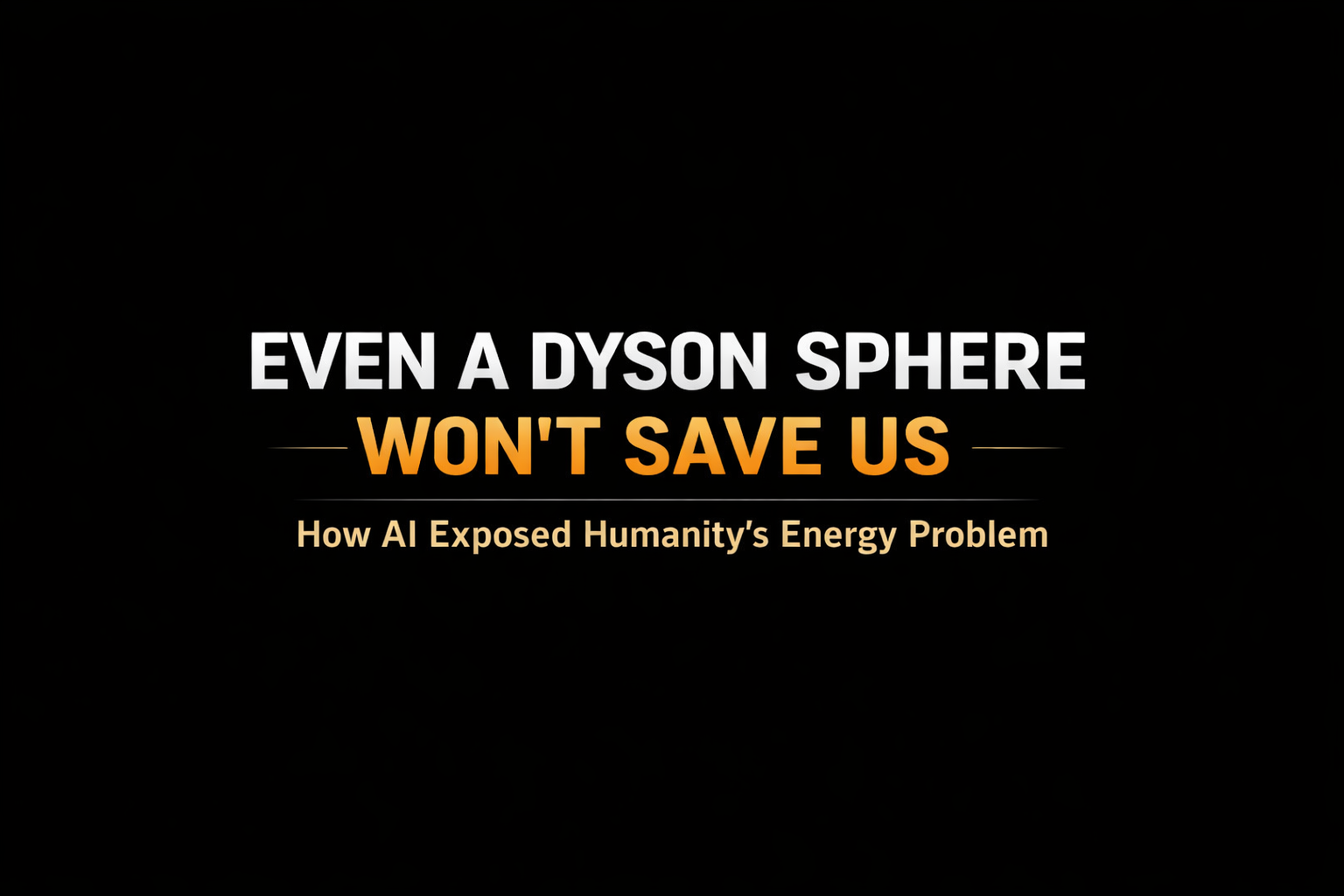
Conclusion: Infinite Energy Won’t Save Us
The Dyson Sphere was supposed to be the answer to civilization’s energy needs.
But AI has shown me something darker:
Even infinite energy won’t fix a civilization that doesn’t respect it.
Until we value efficiency again—until we ask why something should exist, not just whether it can—we’ll keep burning power on nonsense.
And when the lights finally do go out, we won’t be able to say we weren’t warned.